Solo dining etiquette and easy restaurant formats in Seoul
Choose Seoul restaurants by portion format, read Korean minimum-order signs, and handle a meal for one without second-guessing the etiquette.
Quick answer
Eating alone in Seoul is normal enough to have its own everyday word, honbap (혼밥). The easiest choices are restaurants built around one bowl, one tray, a counter seat, a kiosk, or a clearly priced single-person set. The awkward part is rarely arriving alone; it is choosing a shared dish that has a two-person minimum, so read the full menu line and ask before sitting down when the portion format is unclear.
Being alone is not the difficult part
Seoul's official tourism guide now presents eating alone as an ordinary part of solo travel and points out that a visitor does not need to live on fast food. That is the useful starting point: you do not need to apologize for asking for one seat, and you do not need a special “solo traveler restaurant” for every meal.
What matters is how the kitchen sells the food. A restaurant can be perfectly happy to seat one guest but serve its signature dish only as a pot for two. Another may have four-seat tables yet sell every soup as an individual bowl. Judge the menu unit, not the furniture or how many groups you can see through the window.
At the entrance, say 한 명이에요 (*han myeong-ieyo*, “one person”) or 혼자 왔어요 (*honja wasseoyo*, “I came alone”). Then let the staff choose the seat. A counter, a narrow wall seat, or a shared table is not a demotion; it is often the layout that keeps a solo meal simple during a busy service.
Restaurant formats that are easiest for one
These formats usually require the fewest decisions, though the exact branch and menu still need a current check.
One bowl or one plate per order
Soup, rice, and noodle specialists are the best default. Look for dishes such as gukbap (soup with rice), seolleongtang (ox-bone soup), kalguksu (knife-cut noodles), naengmyeon (cold noodles), bibimbap, donkatsu, or a rice bowl. The important feature is not the dish name; it is that the menu shows one self-contained serving rather than a large pot or platter.
These places may still bring several banchan side dishes. They are part of the table setting, not evidence that you accidentally ordered a group meal. Eat what you want without feeling obliged to finish every side dish, and ask before assuming refills or a particular item are self-service.
Gimbap, bunsik, and quick casual shops
Shops centered on gimbap, dumplings, tteokbokki, noodles, or simple rice dishes often have compact menus, quick turnover, and items that can be ordered separately. Ordering may happen with a person, a ticket machine, or a touchscreen. Check whether the screen is set to 매장 (eat in) or 포장 (takeout) before paying.
This format is useful between sightseeing stops because a full restaurant ritual is unnecessary. It is not automatically suitable for allergies, vegetarian diets, or low-spice needs; the broth, sauce, filling, and shared equipment still need their own check.
Food halls, cafeterias, and tray service
A venue where you choose one stall, receive a pager or number, and collect one tray removes most of the seating uncertainty. Find a seat only according to the venue's process—some places expect ordering first, while others require a table number. Return the tray when a return station is marked 퇴식구 or when everyone else is clearly doing so.
The advantage is choice and visible portions. The tradeoff is that a busy food hall can make ingredient questions harder, so it is better for an uncomplicated order than for a high-stakes dietary conversation.
Counters and purpose-built solo seats
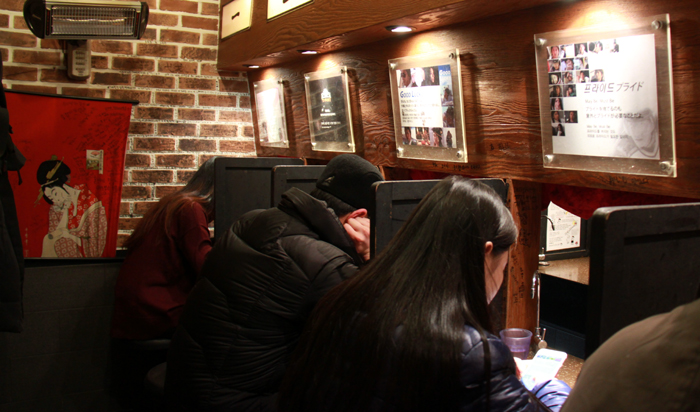
Ramen counters, open-kitchen bars, partitioned booths, and other one-person layouts make the intention obvious. Some grill restaurants also have individual equipment, but do not assume every meat restaurant works that way. Confirm that one serving can be ordered and that the seat is actually offered to a solo guest before building the day around it.
Counter seating can also appear in expensive reservation restaurants. “Counter” describes the seat, not the price or walk-in policy, so keep the reservation status in a separate field.
Markets as a flexible snack stop
A stool at a stall can be easy for one, especially when the food is sold by piece, skewer, bowl, or small plate. A market becomes less simple when the portion is a large platter, the only seats belong to another vendor, or the queue leaves no room to translate a menu. Treat market food as a flexible stop unless you have confirmed the exact stall, portion, payment method, and seating arrangement.
Formats that need one question before you commit
Pause at the door when the menu revolves around a shared grill, a whole chicken, a large hot pot, jeongol, jjimdak, a seafood platter, a family-style set, or a multi-person course. Some businesses offer a smaller option; others enforce a minimum number of servings even when only one person is eating.
The most useful menu signals are:
- 1인분 — one serving. This states the size or price unit; it does not always mean the restaurant accepts an order of only one serving.
- 2인분 이상 주문 — order at least two servings.
- 2인 이상 — for two or more people.
- 1인 1메뉴 — one menu item per guest.
- 1인 식사 가능 or 혼밥 가능 — solo dining is possible.
- 2인 세트 — a two-person set.
- 추가 주문 — additional order; this may appear beside items that cannot be the first or only order.
Read the note beside the dish and any notice at the top of the menu. If the line is still unclear, ask 이 메뉴는 1인분 주문 가능해요? (“Can I order just one serving of this dish?”) or 2인분부터 주문해야 해요? (“Do I have to order at least two servings?”). A polite no is useful information, not a judgment about solo diners.
A calm entrance-to-exit routine
- Check the exact branch before walking over. Save the Korean name, current map pin, recent menu image, service period, and whether reservations are used. Different branches of the same brand can have different seating and ordering systems.
- State that you are one person at the door. Wait to be directed instead of occupying an empty table. If there is a queue terminal, look for 1명 (one person) when entering party size.
- Confirm the minimum before ordering a shared-looking dish. Point to the exact menu line; asking a general “Can I eat alone?” may get a yes even though that particular pot still starts at two servings.
- Follow the ordering system in front of you. VISITKOREA notes that Korean restaurants increasingly use self-service water and side-dish stations or unmanned ordering machines. A call button may be on the table, while spoons, chopsticks, and napkins may be in a drawer under its edge.
- Watch for what is self-service. 물은 셀프 means water is self-service, and 반찬은 셀프 means side dishes are. Take a modest amount first; you can return if refills are offered.
- Check where payment happens. Use 결제는 어디서 해요? (“Where do I pay?”) if it is not obvious. Some places take payment when ordering and others at a counter after the meal. Tipping is not customary at ordinary Korean restaurants.
Etiquette that matters more than eating alone
Solo dining does not create a separate code of manners. The helpful habits are the same ones that make any compact Seoul restaurant work smoothly.
- Sit where staff direct you, particularly when a small room is balancing counters and group tables.
- Keep luggage out of aisles and off any seat the restaurant needs. A station locker or hotel drop is more useful than trying to fit a suitcase under a narrow table.
- Respect the written minimum instead of ordering one serving and expecting an exception after food preparation begins.
- Use the spoon for rice and soup if that is easier, and the chopsticks for other items. Do not leave either utensil standing upright in a rice bowl.
- Use serving utensils when they are provided for shared banchan, and do not reach across another guest's tray at a communal counter.
- Return dishes or trays only where the restaurant indicates. “Self-service” can cover water and banchan without meaning that you should clear the whole table yourself.
- A quick-turn noodle shop is a place to eat, not an improvised laptop desk. Enjoy the meal at a normal pace, but move longer planning sessions to a cafe that permits them.
You do not have to perform elaborate drinking etiquette when nobody is sharing alcohol with you, and there is no need to mimic every gesture at neighboring tables. A greeting, a clear order, ordinary consideration, and 잘 먹었습니다 (*jal meogeotseumnida*, “I ate well,” used as thanks after a meal) are enough.
Give each neighborhood one easy meal and one backup
The most tiring solo-food plan is a list of famous restaurants scattered across the city. Instead, attach a low-friction format to the area you are already visiting: a bowl meal near a palace day, a counter or food hall near shopping, and a confirmed late option near the hotel. Then save one backup that works without a reservation or group minimum.
Record the dish format, not just the restaurant name. “Noodle bowl, one order possible, kiosk, counter seats” remains actionable when you are tired. “Viral restaurant” does not. The Seoul food map spreadsheet is the natural place to keep the Korean branch name, map link, solo-order evidence, minimum, payment flow, and backup on the same row.
If the backup is a packaged meal rather than another restaurant, use the Seoul convenience-store meal planning guide to check heating, eat-in availability, storage, and the exact branch instead of assuming every shop has the same setup.
SeoulSheets connection
In SeoulSheets, add fields for meal role, exact branch, Korean name, one-person format, planned dish, minimum order, seat type, kiosk or counter, reservation status, service checked on, dietary note, and nearby backup. Filter by the neighborhood of the day before filtering by popularity.
Use three simple confidence labels: easy for one, ask first, and group-format backup only. That turns solo dining from a courage test into a visible menu decision—and stops one uncertain dinner from pulling the entire itinerary across Seoul.
The rule to remember
Say “one person” without apology, then check the unit being sold. One bowl, one tray, or a clearly allowed single serving is the easy default; a shared pot or grill needs a minimum-order question. Follow the restaurant's seat and self-service system, keep a nearby backup, and solo dining in Seoul becomes one of the simplest parts of the day.